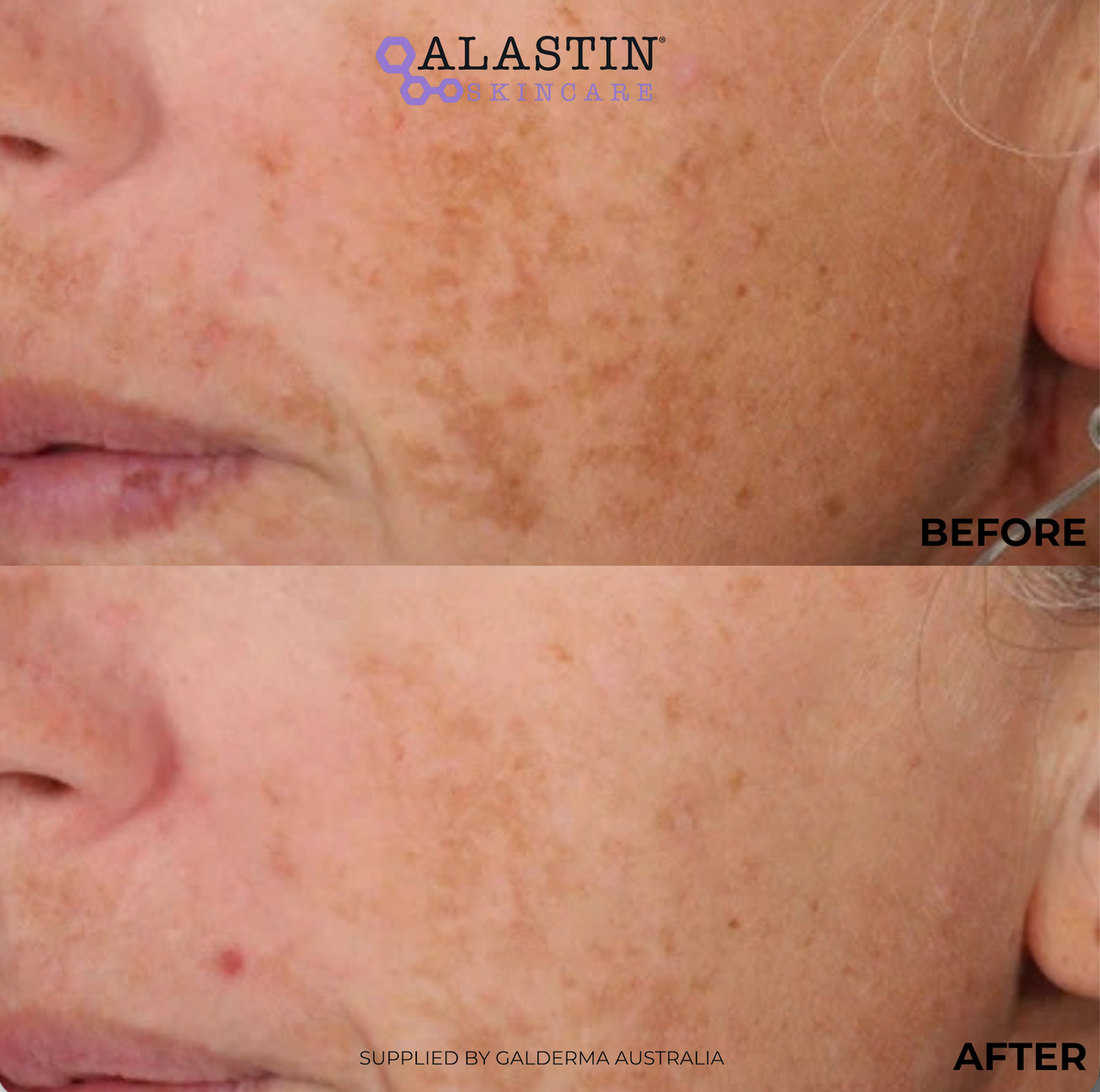
Pigmentation forms through several stages, and this formula addresses more than one of them without using a retinoid or an acid.
Tranexamic acid
A synthetic derivative of the amino acid lysine, originally developed as a medicine to reduce bleeding. Its use in pigmentation came from an accidental observation: patients taking it orally showed lightening of melasma.
The mechanism connects to the same pathway. UV exposure increases plasmin activity in keratinocytes, which releases signals that stimulate melanocytes to produce pigment. Tranexamic acid interrupts that signal before melanocyte stimulation occurs.
That is upstream of melanin production, which makes it complementary to ingredients that inhibit the enzyme that builds melanin, rather than duplicating them.
Niacinamide, high in the formula
Fourth position. Niacinamide interferes with the transfer of melanin from melanocytes to surrounding keratinocytes. Pigment is still produced, but less reaches the visible surface.
It also supports barrier lipid production and has documented anti-inflammatory activity, both of which matter here since inflammation drives post-inflammatory pigmentation.
Glucosyl hesperidin
A modified form of hesperidin, a citrus flavonoid. Attaching a glucose molecule makes it considerably more water-soluble and more stable than hesperidin itself, which is difficult to formulate.
Studied for antioxidant activity and for effects on microcirculation.
The peptides
Hexapeptide-11 is one of the two peptides in Alastin's TriHex Technology, carried here alongside hexapeptide-12.
Pentasodium tetracarboxymethyl acetylhydroxyprolyl dipeptide-12 and pentasodium tetracarboxymethyl dipeptide-51 are chelating peptides, designed to bind metal ions. That matters for pigmentation specifically: tyrosinase, the enzyme that initiates melanin synthesis, requires copper at its active site. Binding copper reduces its activity indirectly.
The botanical layer
Several are more than decoration here.
Silybum marianum is milk thistle, containing silymarin, a well-studied antioxidant complex. Withania somnifera is ashwagandha, an adaptogen with documented antioxidant activity. Diglucosyl gallic acid is a stabilised derivative of gallic acid, studied for effects on tyrosinase.
Pancratium maritimum is sea daffodil, which appears in pigmentation formulations. Thermus thermophilus ferment is derived from a bacterium found in hot springs, used for antioxidant properties. Dunaliella salina is a carotenoid-rich microalga.
Plankton extract
Worth singling out. Plankton extract is the usual INCI listing for photolyase, a DNA repair enzyme that acts on UV-induced lesions in DNA using visible light energy.
That belongs to a distinct category: antioxidants prevent damage, DNA repair enzymes act after it has occurred. Given that UV damage is the primary driver of most pigmentation, its inclusion here is logical rather than decorative.
The delivery question applies. Enzymes are large proteins and the barrier excludes proteins, so effectiveness depends heavily on the delivery system.
Lactoferrin
A milk-derived protein with iron-binding and antimicrobial properties, studied for anti-inflammatory activity. Its presence means this product is not vegan, and it is relevant if you have a milk allergy.
Hydration and finish
Tremella fuciformis is snow mushroom, a polysaccharide with substantial water-holding capacity. Betaine, mannitol and fructose are humectants. Squalane sits at position two, providing a lipid layer.
Silica, tin oxide and titanium dioxide are light-diffusing particles giving a subtle soft-focus finish on application. That part is optical and washes off, distinct from anything the actives do over months.
What is not in it
No fragrance, no essential oils, no declared allergens, no alcohol, no retinoid and no exfoliating acid.
That is unusual in a brightening product, where retinoids and acids are the conventional approach, and it makes this a reasonable option for skin that cannot tolerate them or for anyone avoiding retinoids.